25 min read
On x Erewhon: Why This Brand Partnership Actually Works
The On x Erewhon partnership goes beyond co-branding. See how audience alignment, lifestyle branding, and customer behavior make this collaboration work.
Most brand collaborations start with two logos and work backward.
Find two recognizable names. Put them on the same product. Create a limited-edition colorway. Shoot a campaign. Generate some social buzz.
Sometimes it works.
Sometimes it feels like two marketing departments needed something to announce.
On x Erewhon falls into a different category.
A Swiss performance brand built around movement has partnered with a Los Angeles grocer that has become almost inseparable from modern wellness culture.
And somehow, it makes sense before you even see the products.
That is what makes the collaboration interesting from a marketing perspective.
The strongest part of the partnership isn't the shoe, the apparel, or even the Erewhon juice.
It is the behavioral overlap between the two brands.
What Is the On x Erewhon Partnership?
In May 2026, On and Erewhon announced a multi-year partnership spanning product, community, and culture.
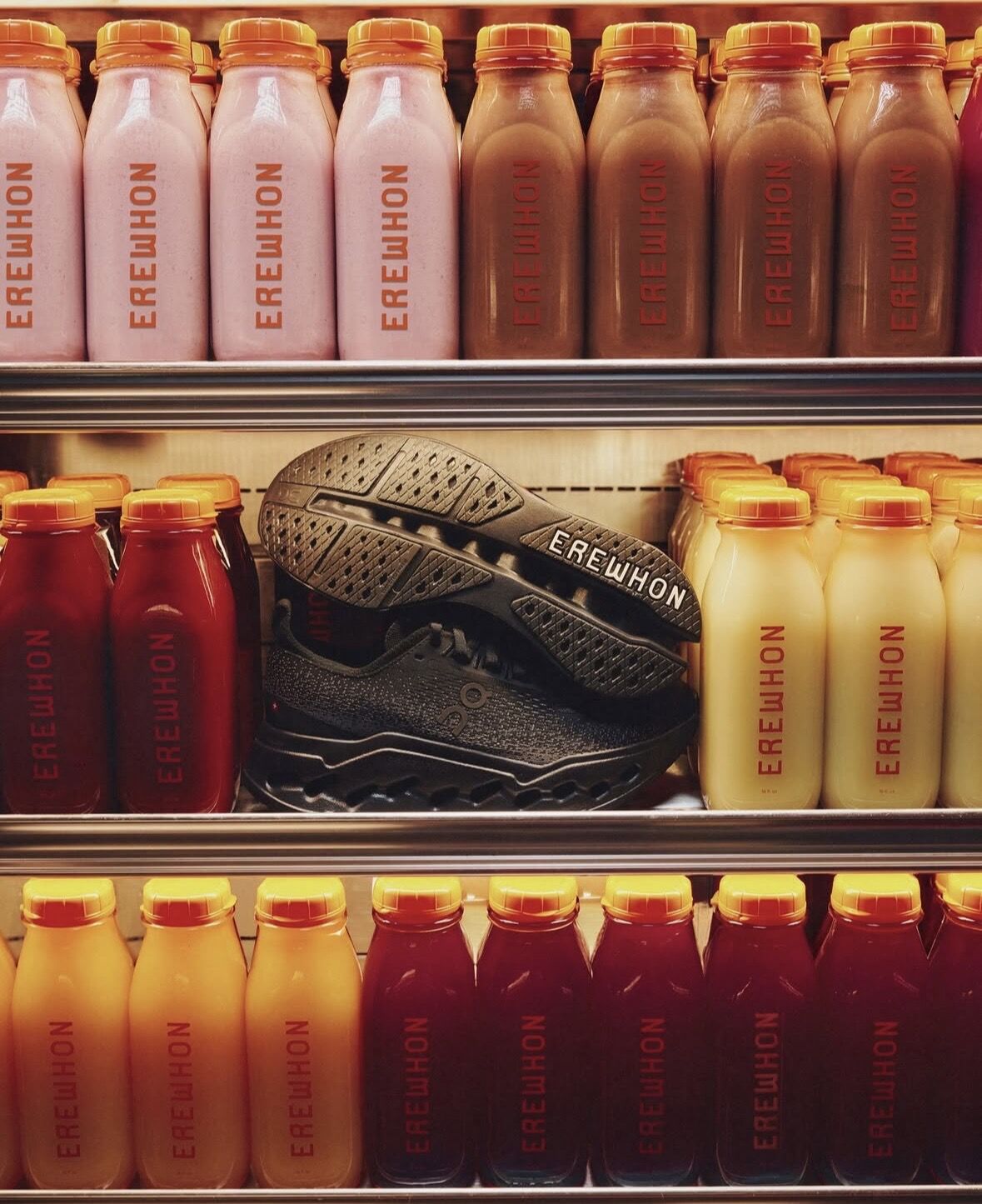
The first phase includes an On x Erewhon running collection, the On x Erewhon Wellness Club, a co-branded recovery juice, apparel, footwear, and activations across Los Angeles. The capsule launched on May 28, with On's Cloudsurfer Max forming one of the central products in the collection.
On describes the collaboration simply as:
“Premium Swiss design meets organic LA wellness.”
That positioning explains most of the strategy.
On isn't trying to convince Erewhon's customers to suddenly become interested in something completely unrelated to their lives.
It is moving deeper into a lifestyle they already participate in.
The Smartest Part of the Campaign Is the Grocery Store
The launch campaign was shot inside Erewhon's Manhattan Beach location.
Runners move through grocery aisles as if they're in the middle of a training session, deliberately turning the everyday “grocery run” into an actual run. On itself describes the campaign as reframing the grocery run through movement and performance.
It sounds like a simple creative concept.
Strategically, it does something more important.
It turns Erewhon's physical environment into part of On's brand world.
A normal grocery store is primarily functional.
You enter. Buy what you need. Leave.
But Erewhon has built something different.
For a significant part of its audience, visiting Erewhon is also an expression of taste, wellness, status and lifestyle.
The shopping experience itself has cultural meaning.
On recognized that.
Instead of bringing Erewhon into a traditional running campaign, it brought running into Erewhon.
That distinction matters.
Great Brand Collaborations Enter Behaviors, Not Just Markets
This is where many collaborations go wrong.
Brands usually ask:
“Do we have similar audiences?”
That is useful, but it isn't enough.
The better question is:
“Do our brands naturally exist within the same customer behavior?”
On and Erewhon do.
Imagine the customer the collaboration is speaking to.
They run.
They train.
They think about recovery.
They care about what they eat.
They probably own premium activewear.
They may spend more for products that signal quality, health, design or status.
A morning run, an On outfit and an Erewhon stop do not feel like three separate consumer decisions.
They can easily be part of the same routine.
That is why the partnership feels natural.
On isn't simply entering Erewhon's stores.
It is entering a behavior that already exists.
And that's a much stronger position for a brand to occupy.
This Is Audience Alignment Done Properly
“Shared audience” gets thrown around constantly when marketers discuss partnerships.
But there are different levels of audience alignment.
Two brands can target people with similar demographics and still have very little reason to collaborate.
A luxury watch company and a premium accounting software business might both sell to wealthy professionals.
That doesn't automatically create cultural compatibility.
On and Erewhon overlap at a deeper level.
Their audiences share attitudes.
Performance.
Wellness.
Premium consumption.
Design.
Community.
Self-improvement.
And, whether marketers want to admit it or not, a certain degree of status signaling.
That creates a stronger connection than age, income or location alone.
The partnership isn't effectively saying:
“Erewhon customers might also buy running shoes.”
It is saying:
“The person who shops here may already see movement, nutrition, clothing and wellness as parts of the same identity.”
That is much more powerful.
The Product Isn't the Whole Campaign
There is another smart decision buried inside the collaboration.
They didn't stop at merchandise.
The partnership includes the On x Erewhon Wellness Club, designed around running, training and recovery events in Los Angeles. It also introduced a post-run juice containing ingredients including golden sea moss, liquid magnesium with turmeric, and organic orange juice.
That expands the collaboration across several touchpoints:
You can wear the partnership.
Drink the partnership.
Attend the partnership.
Run with the partnership.
Experience it inside Erewhon's stores.
This is where a brand collaboration starts becoming a small ecosystem instead of a product drop.
The Cloudsurfer Max might get someone through the door.
The Wellness Club gives the collaboration somewhere to go after the launch campaign disappears from everyone's feed.
That's important.
Limited-edition products generate attention.
Communities generate repetition.
The Grocery Shelf Becomes Media
There is another lesson here that marketers should pay attention to.
Brands are constantly searching for more places to advertise.
TikTok.
Instagram.
YouTube.
Podcasts.
Billboards.
Retail media.
But strong brands can turn almost any environment into media when the context makes sense.
For On x Erewhon, the store itself becomes part of the campaign.
The aisle becomes a running track.
The drink becomes a recovery product.
The grocery trip becomes a wellness ritual.
The shopper becomes part of the audience and the environment simultaneously.
This is far more interesting than simply placing an On display near the checkout.
The environment tells the story.
That is experiential marketing without needing to build an elaborate temporary installation from scratch.
The existing customer experience does most of the work.
Both Brands Benefit Without Losing Their Identity
The best collaborations create something new without making either brand feel less like itself.
On gains access to Erewhon's position within Los Angeles wellness culture.
Erewhon gains another connection to performance, running and premium athletic culture.
Neither brand needs to dramatically change its positioning.
That's crucial.
Weak partnerships often require paragraphs of explanation before customers understand why the brands are together.
Strong partnerships usually produce a simpler reaction:
“Yeah, that makes sense.”
On x Erewhon passes that test.
There Is Also a Useful Lesson About Modern Luxury
The collaboration reflects a broader shift in what premium consumption looks like.
Luxury is no longer limited to watches, handbags, cars and hotels.
A $200 performance shoe can be premium.
An organic grocery run can be premium.
A recovery drink can be premium.
A fitness class can be premium.
Consumers increasingly build their identity through combinations of products, experiences and routines rather than through one obvious luxury purchase.
That creates opportunities for brands that understand adjacent categories.
A running company doesn't necessarily need another sports company as its next partner.
It might find more cultural relevance by partnering with the place its customers visit after they run.
That is exactly why adjacency can be more interesting than similarity.
What Brands Can Learn From On x Erewhon
The lesson isn't that every fitness company should find a trendy grocery store.
The strategy is more transferable than the execution.
Before your next brand collaboration, ask:
1. Do the customers actually behave similarly?
Don't stop at demographics.
Look at routines, purchases, interests and identity.
2. Can both brands contribute something meaningful?
If one company is providing the audience while the other simply adds its logo, the partnership is probably too shallow.
3. Is there a natural moment where the brands intersect?
On found the grocery run.
Your brand might find another everyday behavior where two categories naturally meet.
4. Can the collaboration exist beyond a product?
Products create launches.
Events, communities, experiences and rituals can create longevity.
5. Would the partnership still make sense without the announcement?
This may be the best test.
If customers need a press release to understand why two brands are working together, the strategic connection probably isn't strong enough.
The Real Strength of On x Erewhon
On and Erewhon could easily have produced a shoe, added both logos and called it a collaboration.
Instead, they built the campaign around something far more valuable:
an existing lifestyle.
The customer was already running.
Already thinking about wellness.
Already buying premium products.
Already visiting Erewhon.
The collaboration simply connected those behaviors.
That is why it doesn't feel like two brands trying to borrow relevance from each other.
It feels like two parts of the same consumer world finally meeting.
And that may be the biggest lesson for marketers.
The best partnerships aren't necessarily between brands that look similar.
They are between brands that understand the same person.
At Nitroger, we help businesses turn customer behavior, positioning and market insight into growth strategies that make sense beyond the campaign itself. If your marketing is getting attention but struggling to create meaningful demand, it may be time to look at the strategy underneath it.