37 min read
Netflix’s The Last House Billboard: When OOH Becomes Entertainment
Netflix put a man inside a live billboard for The Last House. Here’s why the stunt is a smart example of experiential OOH and earned attention.
Netflix’s The Last House Billboard: When Advertising Becomes Entertainment
Most billboards have one job:
Get noticed before you drive past them.
Netflix built one people were going out of their way to visit.
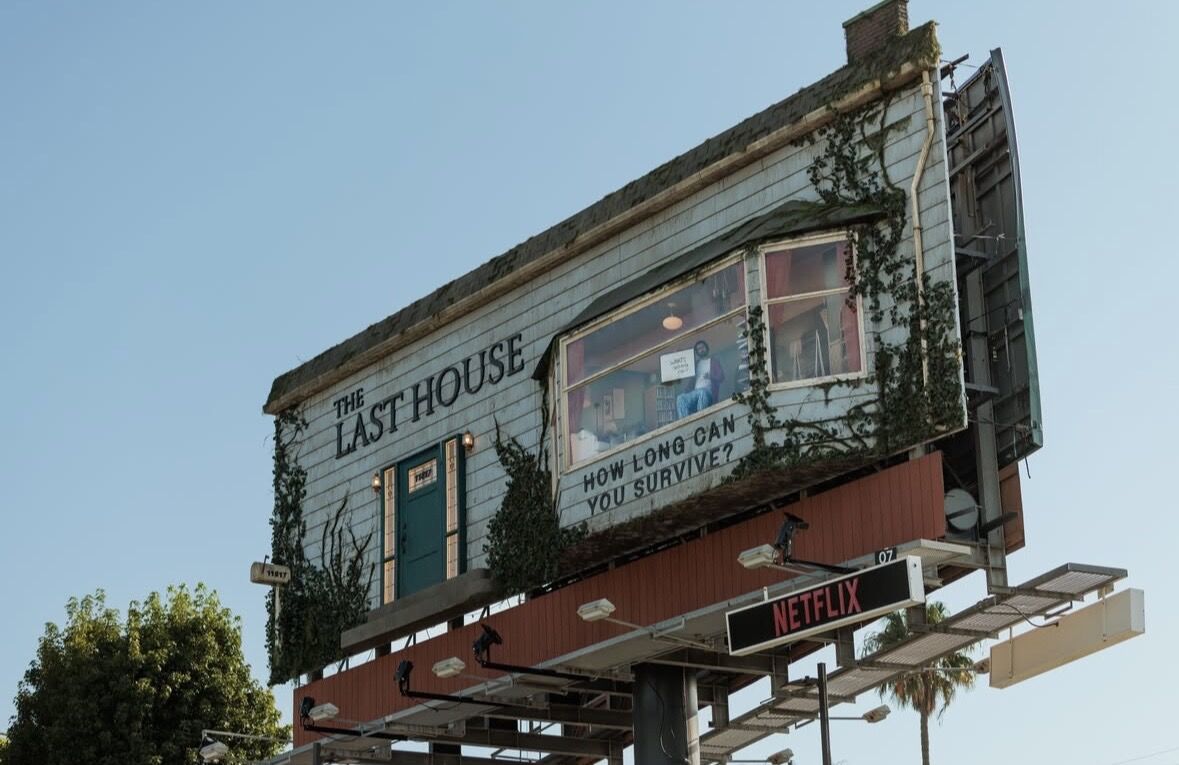
To promote its sci-fi thriller The Last House, Netflix transformed a billboard above Los Angeles' Sunset Strip into a fully furnished room — complete with a chair, table, books, curtains, plants, and one very important addition:
A man living inside it.
Thirty feet above Sunset Boulevard, actor and comedian Nathan Shoop spent several days playing out the premise of the film in public, appearing effectively “trapped” inside the billboard.
He ate.
Stretched.
Read.
Looked at pedestrians through binoculars.
And when people tried to communicate with him from the street, he answered using a whiteboard.
At that point, it stops behaving like a billboard.
It becomes a performance.
And that is what makes the campaign worth studying.
Netflix wasn't simply buying outdoor media to tell people that The Last House was available.
It turned the media placement into a piece of the movie itself.
What was Netflix promoting?
The Last House premiered on Netflix on August 7, 2026.
Directed by Louis Leterrier and starring Greta Lee, Wagner Moura, and Gabriel Barbosa, the sci-fi thriller follows a family mysteriously sealed inside their home and forced to survive as their resources disappear and an unknown force prevents them from escaping.
That premise gave Netflix a particularly useful creative idea to work with.
A family trapped in a house.
So instead of putting an image of that house on a billboard, Netflix effectively put the house inside the billboard.
The installation sat above Sunset Boulevard near Selma Avenue in West Hollywood, recreating a furnished living room roughly 30 feet above the street. The live activation began around the movie's release weekend, with Shoop interacting with passersby while apparently unable to leave.
The billboard also posed a simple question:
“How long can you survive?”
That's far more interesting than:
“The Last House. Streaming August 7.”
Same product.
Very different level of attention.
Most billboards Interrupt. This one created curiosity.
Traditional outdoor advertising is built around interruption.
You weren't looking for an advertisement.
The advertisement appears in your field of view and gets a few seconds to communicate something.
That creates a brutal creative constraint.
Large logo.
Short headline.
Strong visual.
Done.
Netflix approached the placement differently.
Instead of trying to communicate everything within three seconds, it created something that produced a question almost instantly:
Why is there a man living inside that billboard?
Once that question exists, the viewer does some of the work.
They look longer.
They point it out.
They take a photo.
They search for context.
They tell someone else.
Some even physically go to see it.
The Los Angeles Times reported that at least some local residents sought out the installation after seeing it circulate through social media and messages from friends.
That's the distinction.
A normal billboard needs to repeatedly purchase attention.
A sufficiently interesting billboard can start generating some of its own.
The advertisement became a piece of the story
The smartest part of the campaign isn't that Netflix put a person in a billboard.
A strange stunt alone doesn't make good marketing.
The stunt works because it is directly connected to the product.
The Last House is about people who cannot leave their home.
The billboard contains someone who seemingly cannot leave his room.
The movie asks how people behave while trapped.
The activation lets pedestrians watch someone perform exactly that scenario.
Even the interaction through the whiteboard reinforces the idea of separation between the person inside and the world outside.
That creates what experiential marketing should aim for:
The audience understands the product by experiencing a version of its premise.
Netflix doesn't need a paragraph explaining the movie.
You see a man trapped in a house above Sunset Boulevard.
Then you see:
The Last House.
Connection made.
That is the difference between a stunt and a gimmick
Marketing loves stunts.
Unfortunately, brands sometimes confuse “strange” with “strategic.”
Put a giant object in Times Square.
Have someone wear an unusual costume.
Build a bizarre pop-up.
Hope TikTok notices.
But if people remember the stunt and forget what it was advertising, the brand has built entertainment for everyone except itself.
The strongest activations have a simple relationship between the spectacle and the product.
Netflix's billboard passes that test.
Take the movie away and the installation loses most of its logic.
That's good.
The entertainment and the advertisement are attached.
A useful test for experiential campaigns is:
Could someone explain why this execution exists after hearing the product premise once?
Here, the answer is immediate.
Movie about people trapped inside their house.
Man trapped inside a billboard house.
Done.
Netflix used physical media to create digital content
There's another reason this type of OOH works particularly well now.
The audience for the billboard isn't limited to the people driving down Sunset Boulevard.
The physical activation becomes raw material for digital distribution.
A person sees it.
They film it.
Someone uploads the video.
Another person reposts it.
Media outlets cover the strange man apparently living above Sunset Boulevard.
Netflix later publishes an interview with the performer.
The installation then lives far beyond the physical location where the media was purchased.
CBS Los Angeles covered the billboard while Shoop was still inside, and Netflix's Tudum followed the activation with a feature on the performer after the stunt. Entertainment Weekly and the Los Angeles Times also covered it.
That is where the economics of ambitious OOH get more interesting.
You're not necessarily buying:
One billboard.
You may be creating:
Billboard + social content + PR story + user-generated content + conversation + launch-day visibility.
Not every experiential campaign earns that second life.
But designing for that possibility changes how marketers should think about outdoor media.
The best OOH now has two audiences
There are really two people looking at modern experiential advertising.
Audience One: The Person Standing in Front of It
They experience the installation directly.
For The Last House, that's the pedestrian looking up and wondering why someone is living inside a furnished room above the street.
Audience Two: Everyone Who Sees It Through a Screen
They encounter it through TikTok, Instagram, LinkedIn, a news report, Reddit, or a group chat.
And this second audience can be dramatically larger than the first.
That means physical advertising increasingly needs to work in two formats:
In real life: Is this interesting enough to stop for?
On a phone: Is this interesting enough to watch without being there?
Netflix's activation works in both.
You don't need to stand underneath the billboard to understand why it's unusual.
A five-second clip of someone eating breakfast inside a giant billboard is enough.
That visual portability matters.
Netflix didn't advertise the film. It dramatized the premise.
Entertainment marketing has a built-in advantage that many brands fail to use.
Movies already contain:
Characters.
Objects.
Worlds.
Conflicts.
Locations.
Rules.
Mysteries.
Marketing can borrow from all of them.
Yet a surprising amount of movie advertising still reduces a two-hour story to a poster featuring actors' faces.
Netflix went the other direction.
It took one of the movie's central ideas — confinement — and brought it into the real world.
That makes the campaign function almost like a miniature trailer without actually showing footage.
You don't know precisely what happens in the movie.
But you understand the tension.
Someone is trapped.
They can't get out.
How long can they survive?
That gives the viewer enough information to become curious without explaining everything.
And curiosity is exactly what launch marketing should create.
A billboard people photograph has changed its job
There was a time when the success of outdoor advertising was largely about visibility.
Location.
Traffic.
Reach.
Frequency.
Those still matter.
But increasingly, standout OOH has another potential objective:
participation.
The viewer doesn't just consume the media.
They do something with it.
Film it.
Photograph it.
Scan it.
Walk around it.
Interact with it.
Send it to someone.
Search for it.
Netflix's billboard makes this especially clear.
The installation itself was designed around interaction. Shoop communicated directly with people below through a whiteboard, creating tiny unscripted moments between the performer and pedestrians.
That makes each encounter slightly unpredictable.
And unpredictability makes content more interesting.
You aren't just photographing a static advertisement.
You might capture something nobody else saw.
That is a powerful incentive to pull out a phone.
The media became part of the premiere
Timing matters too.
The installation wasn't placed months before release as a generic awareness campaign.
It was activated immediately around the movie's August 7 premiere.
That compresses the distance between:
What is this?
and
I can watch it now.
This is particularly useful for streaming.
A theatrical campaign may need to persuade someone to check showtimes, travel to a cinema, choose a screening, and purchase a ticket.
With Netflix, curiosity generated on Friday night can become a stream a few minutes later.
The stunt creates attention at almost exactly the moment Netflix can convert it.
That's a strategic detail worth remembering.
A brilliant activation launched at the wrong point in the customer journey can waste momentum.
Attention decays quickly.
The easier it is to act while curiosity is high, the better.
Netflix understands that marketing can be entertainment
This campaign also makes sense coming from Netflix.
The company isn't selling insurance or accounting software.
Its entire product is entertainment.
So its advertising has permission to entertain too.
That sounds obvious, but it creates an important brand advantage.
If Netflix produces a strange real-world experience that people genuinely enjoy watching, the campaign is already demonstrating something adjacent to what Netflix sells:
We know how to keep you interested.
The medium reinforces the brand.
This is where great creative marketing becomes more powerful than product messaging alone.
The campaign doesn't have to say:
Netflix creates compelling entertainment.
It can prove it for 30 seconds on Sunset Boulevard.
What Marketers can learn from The Last House billboard
1. Start with the product truth, not the media format
Don't begin with:
“We need a cool billboard.”
Begin with:
“What is the most interesting thing about what we're selling?”
Then decide what format can make that idea tangible.
For The Last House, confinement naturally became the creative device.
2. Create a question before providing the answer
Curiosity earns attention.
“Why is that person in there?” is stronger than immediately explaining every detail of the campaign.
Give the audience enough information to investigate.
3. Design physical campaigns for digital travel
Ask what the activation looks like through someone else's phone.
If the idea only works when someone is physically present, its potential reach is limited.
The best experiential OOH is understandable even when encountered secondhand.
4. Make participation part of the creative
Shoop didn't simply sit motionless behind glass.
He acknowledged pedestrians.
He responded.
He performed mundane tasks.
The campaign therefore kept producing new moments instead of one static visual.
5. Tie spectacle directly to the product
Attention that doesn't transfer to the brand is vanity.
If you're going to do something unusual, make the reason for doing it inseparable from what you're promoting.
6. Time attention close to conversion
The stunt surrounded the film's release.
That matters.
Whenever possible, build your biggest attention moment when the customer can immediately take the next step.
Not every brand needs a man living in a billboard
There is an obvious danger in studying campaigns like this.
Teams see an elaborate stunt and conclude that good marketing requires bigger budgets, bigger objects, or increasingly absurd ideas.
It doesn't.
The lesson isn't:
Make your billboard crazier.
The lesson is:
Make the media do more than carry the message.
A restaurant might turn a window into a live kitchen demonstration.
A fitness brand might turn a transit shelter into a challenge.
A software company might build an installation that visualizes the problem its product solves.
A local business might create something small enough to cost a fraction of Netflix's campaign but interesting enough for customers to photograph.
Scale changes.
The principle doesn't.
Most billboards are seen. This one was experienced.
That's ultimately what separates The Last House campaign.
Netflix could have purchased a premium Sunset Strip placement, added Greta Lee and Wagner Moura, written “STREAMING AUGUST 7,” and reached plenty of people.
Instead, it made the advertisement behave like the story.
The billboard became a house.
The house got a resident.
The resident became a performance.
The performance became something pedestrians could interact with.
And that physical interaction created a story that could continue across social media and news coverage.
The distinction is simple:
Most outdoor advertising asks for attention.
The best outdoor advertising gives people a reason to give it.
Netflix didn't just put The Last House on a billboard.
For a few days, it made the billboard The Last House.
And that is a much harder thing to walk past.
At Nitroger, we help businesses turn positioning and creative strategy into marketing people actually notice — across digital campaigns, brand experiences, websites, and growth channels. Because getting in front of an audience is only half the job. The harder part is giving them a reason to care.